October payrolls arrive on weak hiring. The Fed is still leaning to a hike.

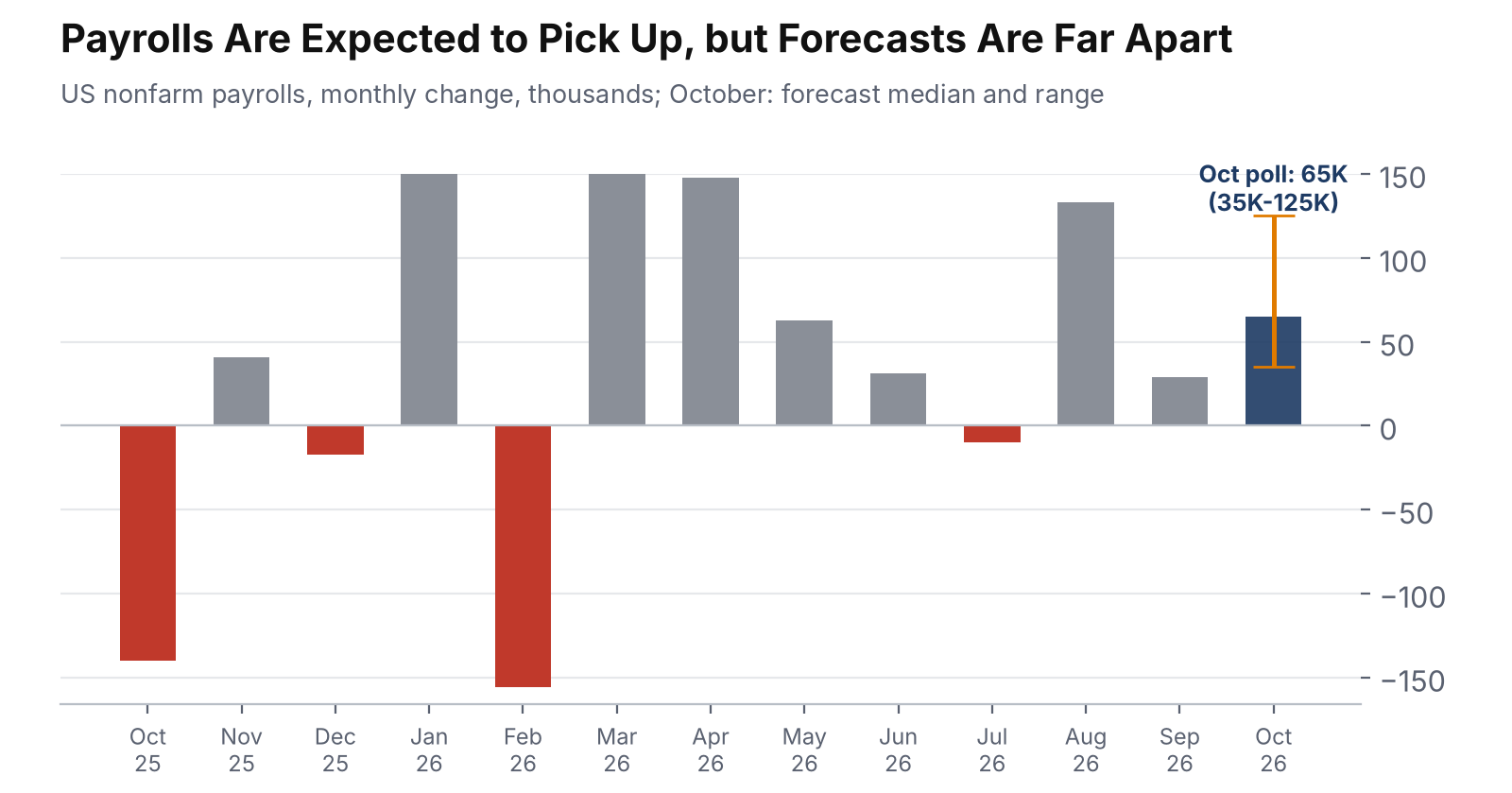
The October jobs report lands on Friday into a Fed that's raising rates, not cutting them. Economists expect 65,000 jobs after only 29,000 in September. So a weak number won't say "rate cuts" this time. It says less pressure for the next hike, and wages and revisions decide how much less.
The short version
- The report is out Friday, 6 November, at 8:30 a.m. ET / 13:30 GMT. The poll median is 65,000 new jobs (range 35,000-125,000) and a 4.2% unemployment rate, after only 29,000 in September.
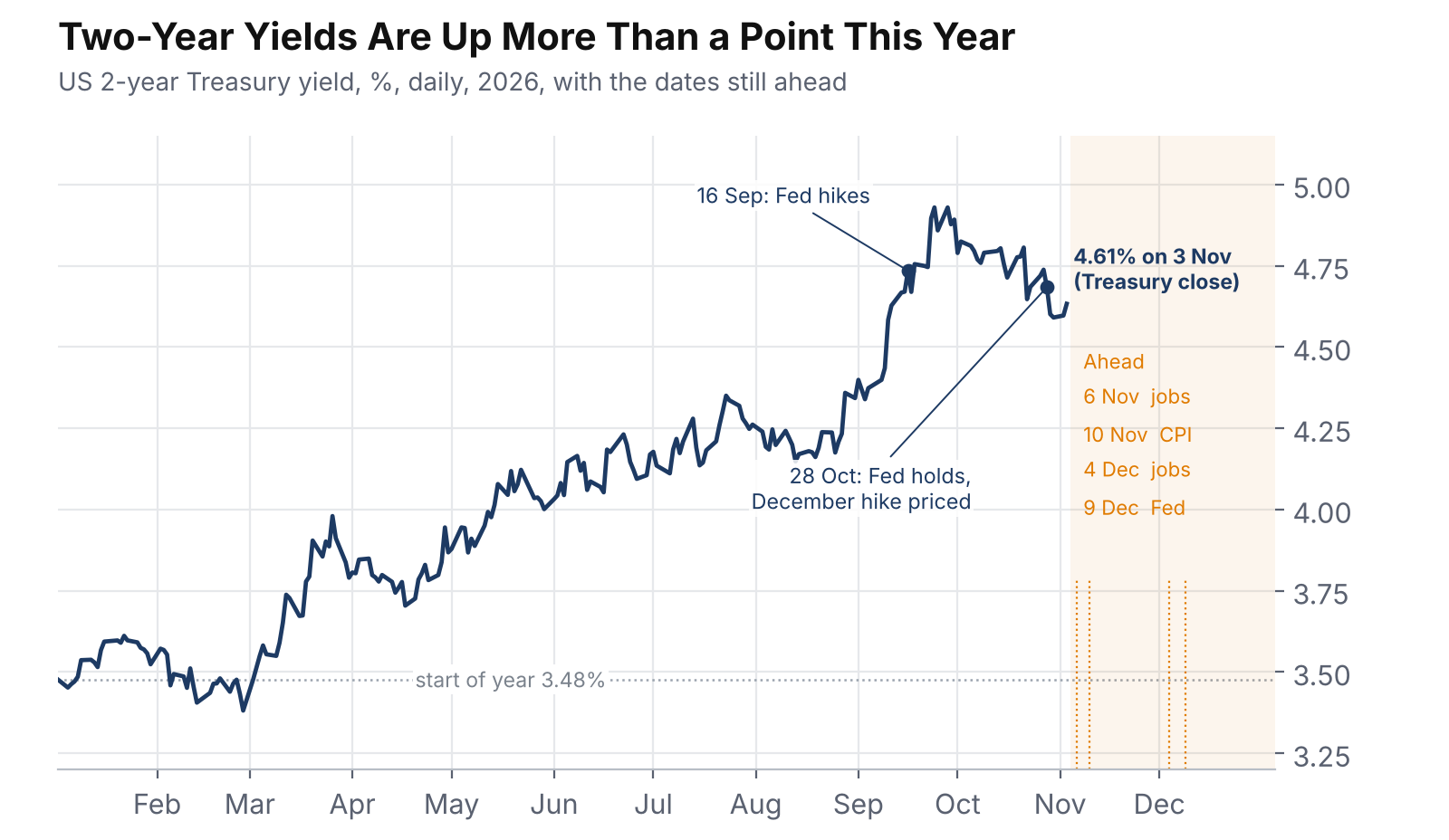
- The Fed raised rates in September, held at 3.75%-4.00% on 28 October with two votes for a hike, and markets price a December hike as the most likely outcome.
- A weak print means less pressure for the next hike. Wages and revisions will decide how much.
Key numbers
| Item | Latest | Expected / next |
|---|---|---|
| Release | Fri 6 Nov, 8:30 a.m. ET / 13:30 GMT | |
| Nonfarm payrolls | +29,000 (Sep) | poll median 65,000 (35,000-125,000, 75 forecasts) |
| Revisions | Jul and Aug revised down 60,000 combined | watch Sep revision |
| Unemployment rate | 4.2% (Sep) | median 4.2% (4.1%-4.3%) |
| Average hourly earnings | +0.1% m/m, +3.0% y/y (Sep) | median +0.3% m/m, +2.9% y/y |
| Job openings (JOLTS) | 7.52 million (Sep, released 3 Nov)Beat | poll median was 7.10 million |
| Fed funds target | 3.75%-4.00% (held 28 Oct, 10-2 vote) | next decision Wed 9 Dec |
| December hike priced | about 78% (Fed funds futures, 3 Nov) | |
| US 2-year / 10-year yield | 4.61% / 4.95% (3 Nov) | |
| ADP October (Wed 4 Nov, 8:15 a.m. ET) | prior 90,000 | median 69,000 |
| ISM services PMI (Wed 4 Nov, 10:00 a.m. ET) | prior 54.9 | median 54.8 |
| Initial jobless claims (Thu 5 Nov, 8:30 a.m. ET) | prior 194,000 | median 196,000 |
What we know going in
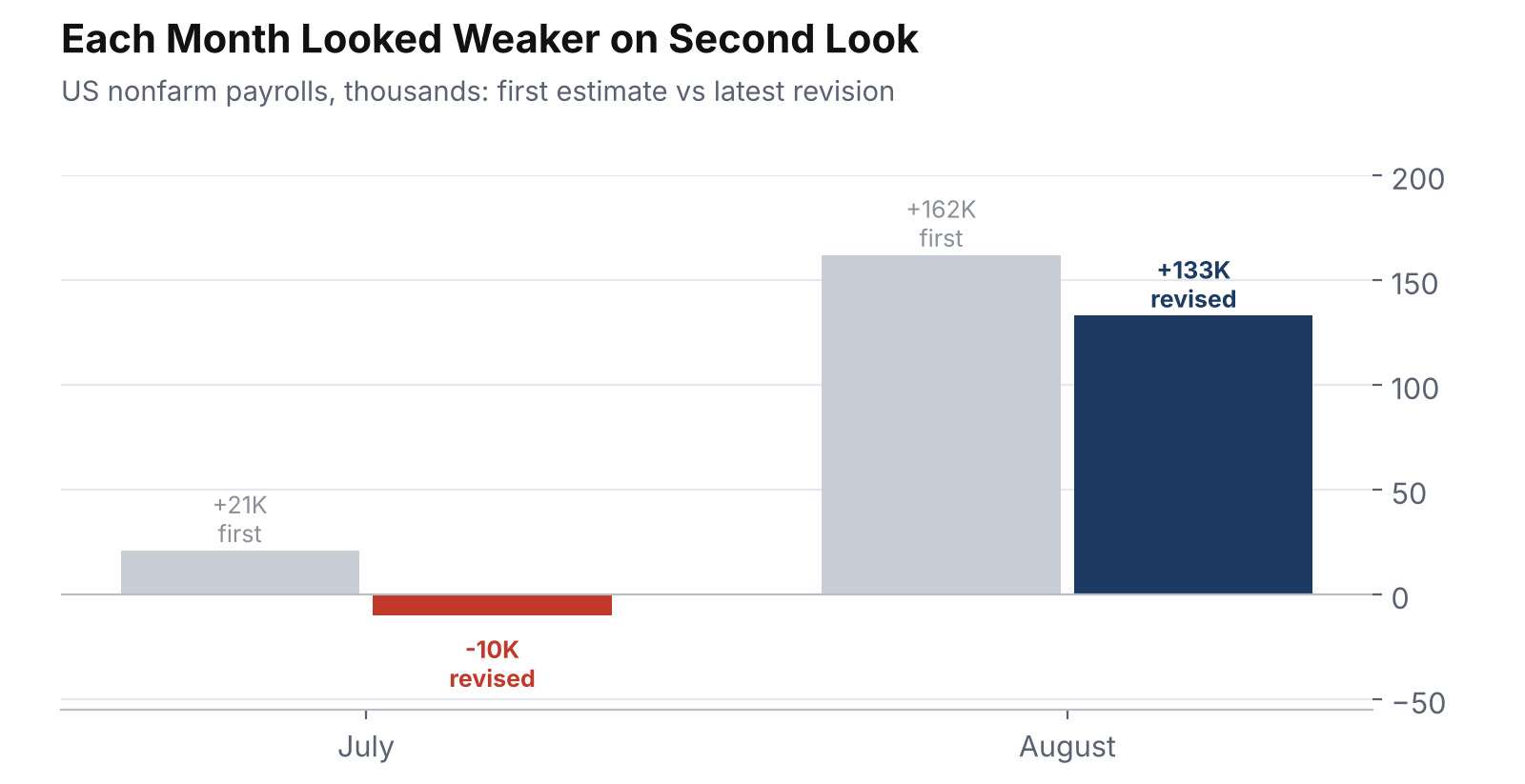
September's report, out on 2 October, showed payrolls up just 29,000. Unemployment rose to 4.2%. July was revised to a loss of 10,000 jobs and August down to 133,000, leaving the two months 60,000 lower than first reported. Average hourly earnings rose only 0.1% on the month and 3.0% on the year.
The Fed didn't take that as a reason to ease. It hiked in September and held at 3.75%-4.00% on 28 October. Governor Lisa Cook and Cleveland Fed President Beth Hammack dissented, both wanting another 25 basis point hike. What's driving the Fed is inflation from the energy shock. The labor market is a side issue.
The BLS release on 3 November showed September job openings jumping to 7.52 million, well above the 7.10 million poll median. Layoffs stayed at 1.6 million, the lowest in about a year and a half. Hiring is slow. Companies aren't firing, though, and they still want workers.

Why this one matters more
- It's the first labor test after a hawkish hold. Two Fed officials already want to hike. A firm report with solid wages makes December an easy call. A weak one gives the majority a reason to wait.
- Wages are the link to inflation. Oil has already pushed inflation up, and the Fed wants to know if it spreads into pay. A wage print well below 3% y/y would ease that fear. A jump would confirm it.
- Revisions have only gone one way. July and August were both revised down in the September report. Another big downward revision would matter as much as the headline.
Scenarios
Illustrative ranges for the first hours, not forecasts.
- Payrolls / wages
- above 100K, wages firm
- Dollar
- higher
- 2-year yield
- higher, hike more certain
- Gold
- lower
- S&P 500
- mixed: growth good, rates bad
- Payrolls / wages
- 50-80K, wages near 3%
- Dollar
- small move
- 2-year yield
- little changed
- Gold
- little changed
- S&P 500
- little changed
- Payrolls / wages
- below 30K or negative revisions, unemployment 4.3%+
- Dollar
- lower
- 2-year yield
- lower, hike odds fall
- Gold
- higher
- S&P 500
- higher at first on lower yields, then a growth question
Across markets
- Dollar: firm on hike pricing. It reacts mostly through the 2-year yield, the rate that tracks Fed expectations most closely.
- Gold: below $4,000 on rising yields. A weak report that cuts hike odds is the clearest near-term support.
- Oil: payrolls don't change oil supply, but oil is why the Fed is hiking. If US-Iran talks bring oil down, the labor data matters less to the Fed.
- Equities: the Nasdaq 100 is in correction territory. Right now stocks need lower yields more than they need strong growth.
What counts as a surprise
A payrolls number only surprises if it lands outside the whole range of forecasts. Missing the median isn't enough. For October that range runs from 35,000 to 125,000. Anything inside it, even at either end, is mostly priced. A print outside it forces a rethink of the Fed path, and the first reaction then gets read through the details: revisions to the prior two months, average hourly earnings and the unemployment rate.
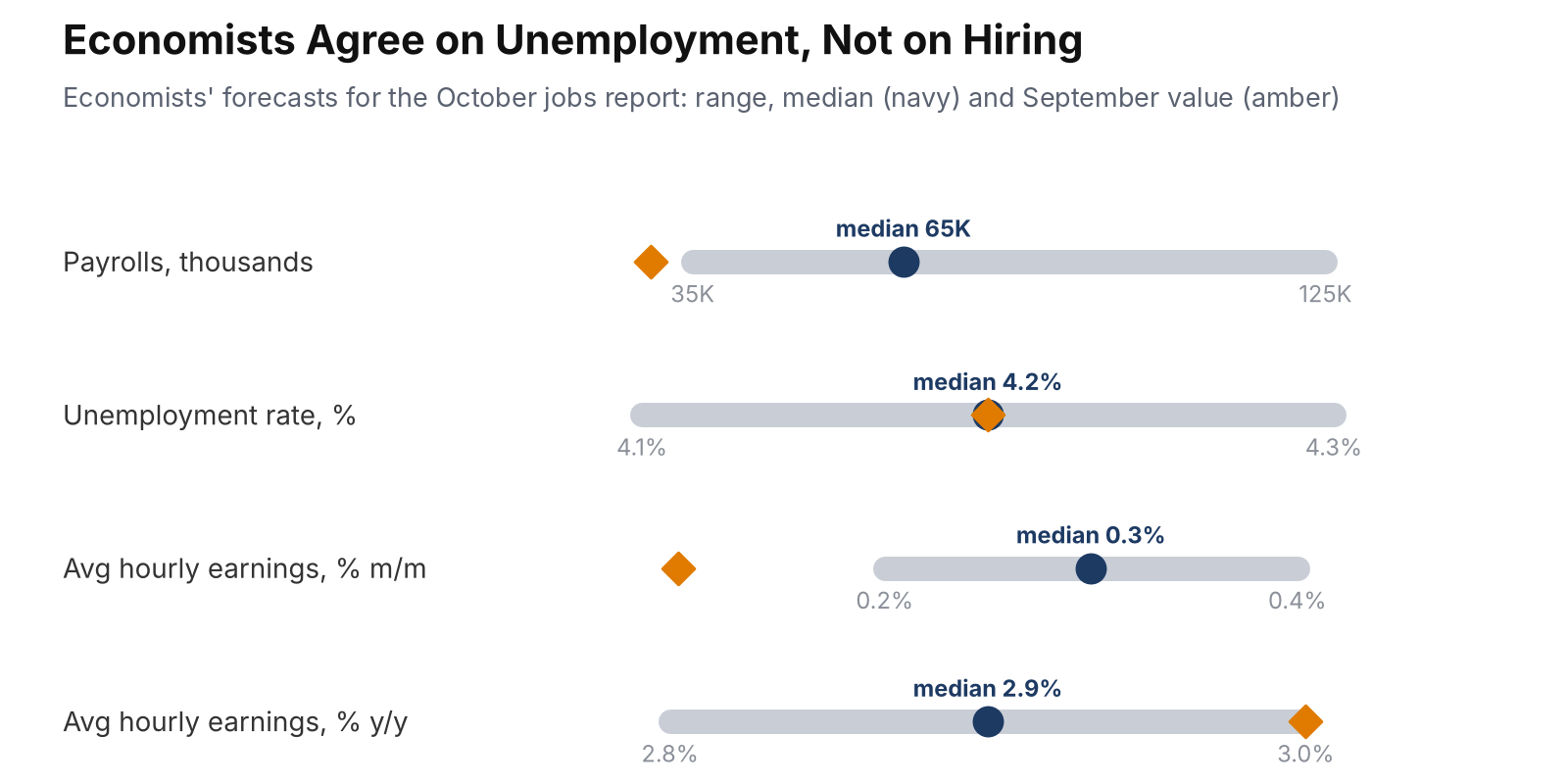
Wages carry extra weight this time. The Fed is hiking because energy prices pushed inflation up, and rising pay is what turns an energy shock into lasting inflation. A firm wage number backs another hike. A soft one lets the Fed argue the shock is passing.
Waiting on Friday
Tuesday showed how much traders are holding back for this report. September job openings came in at 7.52 million, above every forecast in the poll. The two-year yield rose to 4.64% and gave most of it back. The dollar barely moved. With the midterms and payrolls ahead, a strong labor-demand number wasn't enough to shift positions.
In our narrative register, the Fed path story is "unwinding, paused": the market has stopped adding hikes but hasn't taken any out. The December Fed funds futures contract implies an average rate of 4.02% against an effective rate of 3.88% today. That works out to about a 78% chance of a quarter-point hike on 9 December. Our labor-market narrative has been asleep since mid-September. It only wakes on a clearly weak report, or weekly jobless claims climbing toward 230,000, with the two-year yield and the dollar falling together.
Positioning and the dollar
Our desk sees no clear direction for the dollar going in. US data have beaten expectations more often than in other G10 economies, which helps. But the rate gap with other countries has narrowed, and positioning cuts the other way. Leveraged funds hold one of the largest net short euro positions of the past three years (week to 27 October), and speculators hold a record net short in the Australian dollar. Positions that crowded can unwind fast if a weak report pulls US yields lower.
The bull and bear case for the dollar
A Fed still hiking while openings sit near 7.5 million and layoffs stay low. A firm report keeps December on track.
Three months of weak payrolls and downward revisions. If unemployment rises again, the market will start pricing the end of the hiking cycle.
What's next
- 6 Nov
Fri 6 Nov, 8:30 a.m. ET: October jobs report.
- 10 Nov
Tue 10 Nov, 8:30 a.m. ET: October CPI.
- 4 Dec
Fri 4 Dec, 8:30 a.m. ET: November jobs report, the last one before the Fed decision.
- 9 Dec
Wed 9 Dec: FOMC decision.
What would change the picture: unemployment at 4.4% or higher, or wage growth back above 3.5% y/y.
How do traders prepare for jobs day and handle the release? Our mentors walk through it in how to trade NFP.
Covers earnings, central banks and cross-market moves for the Prime Terminal Market Desk.
Market information, not investment advice.