Oil drops 7% on US-Iran talks. Gold slides as yields stay high.

Oil lost more than 7% in a day as the US and Iran opened the door to diplomacy, and a US strike on Qeshm Island didn't bring the buyers back. Gold got no safe-haven bid either. It's trading rates now, and with oil keeping central banks on a hiking path, rates are working against it.
The short version
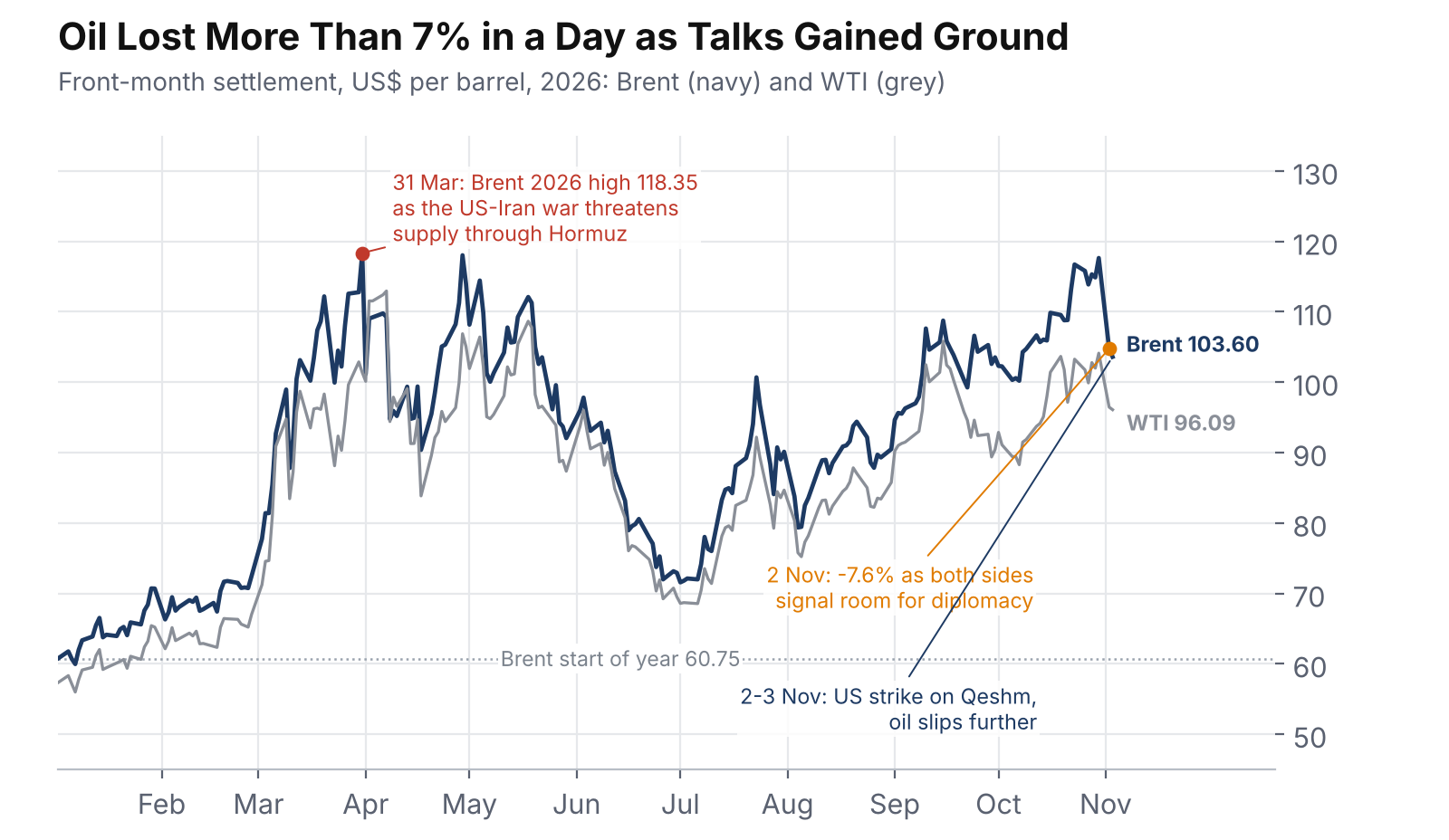
- Oil fell more than 7% on Monday, 2 November, as the US and Iran signaled room for diplomacy. It slipped another 1-2% on Tuesday to about $103 Brent and $96 WTI, even after a US strike on Iran's Qeshm Island.
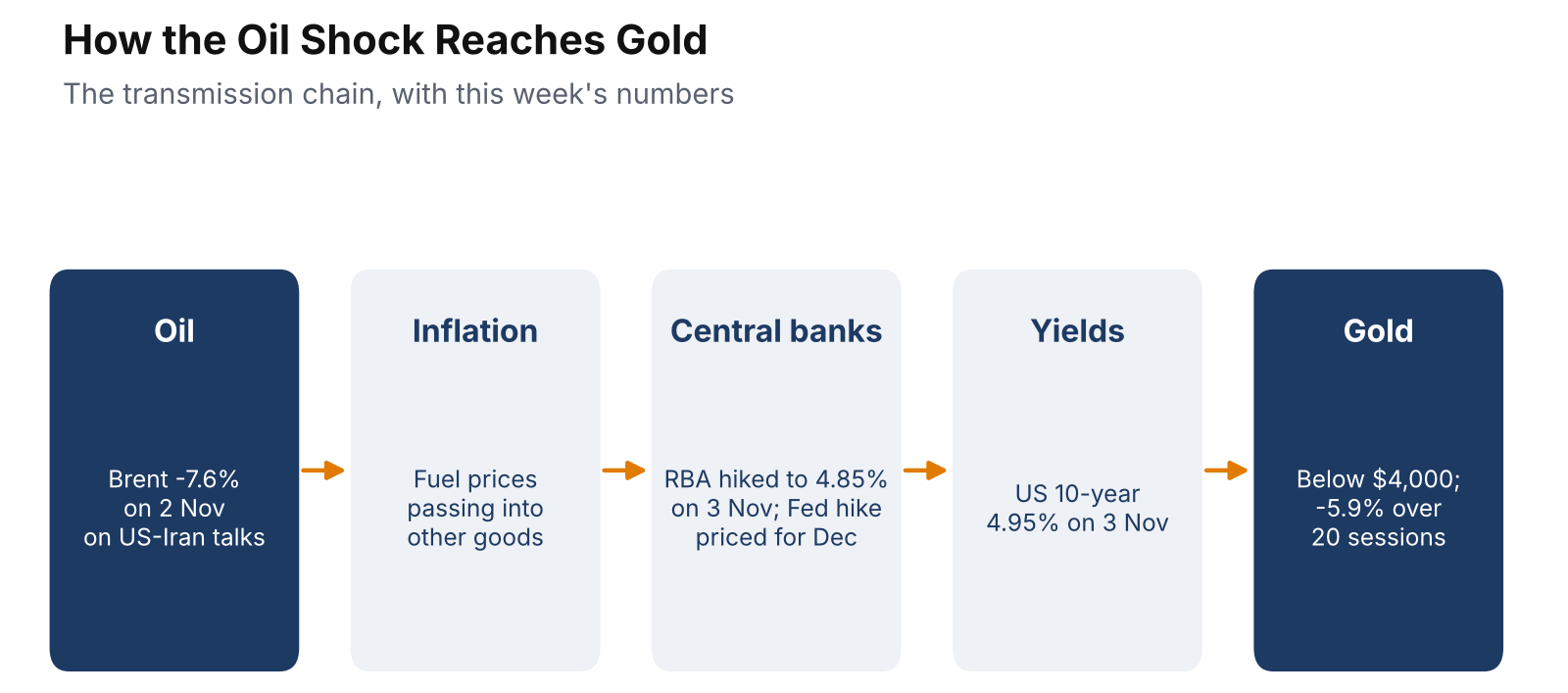
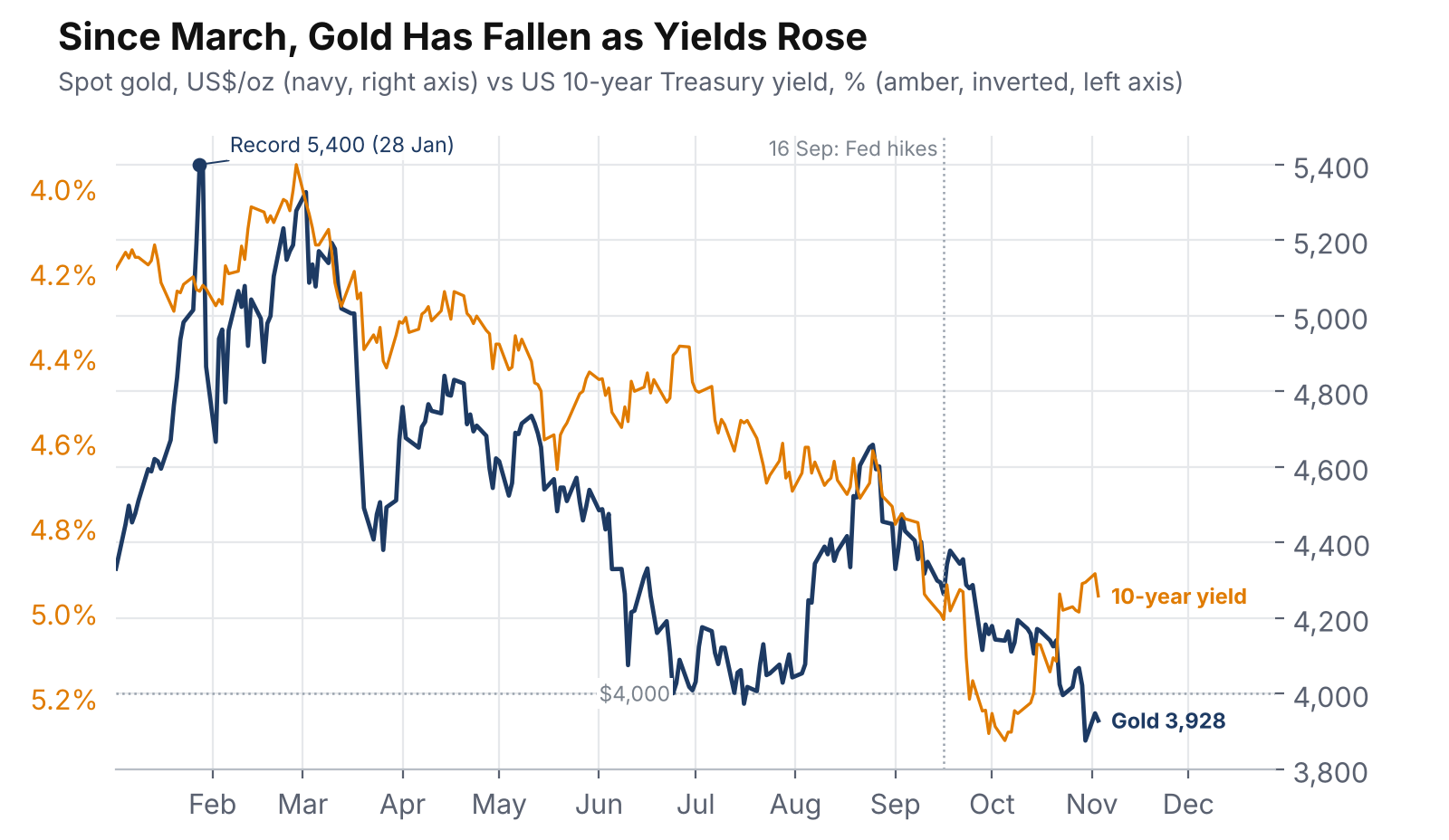
- Spot gold fell 0.5% to $3,927 on Tuesday as the 10-year Treasury yield rose to 4.95% and the dollar firmed. It's down about 6% over 20 sessions.
- Rates tie the two together. High oil keeps central banks hiking: the RBA raised rates on 3 November and cited fuel prices, and markets price a Fed hike in December. That weighs on gold whether tensions rise or fall.
Key numbers
| Item | Level / move | Notes |
|---|---|---|
| Brent, Mon 2 Nov settle | $104.77, -7.6% | January contract |
| WTI, Mon 2 Nov settle | $96.46, -7.4% | December contract |
| WTI, Fri 30 Oct settle | $104.12 (intraday high $104.99) | the level before the drop |
| Brent, Tue 3 Nov settle | $103.60, -1.1% (low $100.80) | |
| WTI, Tue 3 Nov settle | $96.09, -0.4% (low $93.59) | |
| Spot gold, Tue 3 Nov | $3,927.18, -0.5% | 2:06 p.m. ET / 19:06 GMT |
| Spot gold, 20 sessions | about -5.9% | to 3 Nov |
| US 10-year yield | 4.95% (4.91% on 2 Nov) | 3 Nov |
| US 2-year yield | 4.61% (4.59% on 2 Nov) | 3 Nov |
| RBA cash rate | +25 bp to 4.85% | 3 Nov |
| Fed December hike, priced | about 78% | Fed funds futures, 3 Nov |
What happened
Oil fell more than 7% on Monday, 2 November. The US and Iran both signaled room for diplomacy, and a draft proposal to end the US-Iran war circulated after Iranian negotiators left Qatar. Caution ahead of the midterm vote added to the selling.
Late on Monday, around 21:00 GMT, came reports of explosions on Qeshm Island in the Strait of Hormuz. By early Tuesday it emerged that the US had struck an anti-aircraft facility there, and US officials called the strikes "defensive." President Trump confirmed the strike and played it down: "Just a minor attack. It wasn't war."
Oil ticked up on the first reports in Asian trading, then gave it back. By mid-morning in New York, Brent was 2% lower at $103.14 and WTI 1% lower at $95.79. The same day, Qatar's foreign ministry said both sides were committed to reviewing mediator proposals but that differences remained. Iran's foreign minister said a proposal under discussion could reopen the Strait of Hormuz within two days if Washington met a set of conditions.
Gold fell for a second session, to $3,927.18 by the afternoon, touching $3,893 at the low. The dollar and Treasury yields rose.
Why the market reacted
- The risk premium is leaving oil. Part of the oil price pays for the risk that supply through Hormuz stays shut. Every step toward a deal shrinks that risk, so the premium comes out fast. A strike framed as limited, with talks still going, didn't put it back.
- The market is trading the talks now. Earlier in the year, the Qeshm strike would have lifted oil. This week it was read as pressure inside a negotiation. That tells you where positioning sits: traders expect a deal and need a clear breakdown to change their minds.
- Gold is trading rates, not fear. The energy shock pushed inflation up and central banks into hikes. Higher real yields raise the cost of holding a metal that pays no interest. So gold falls when tensions ease, on less safe-haven demand, and also when oil keeps inflation high, on more hikes.
Across markets
- Rates: the US 10-year yield rose from 4.91% to 4.95% on Tuesday and the 2-year from 4.59% to 4.61%. Fed funds futures priced about a 78% chance of a December hike on 3 November.
- Central banks: the Reserve Bank of Australia raised its cash rate by 25 basis points to 4.85% on 3 November, on a 6-3 vote. Its statement said inflation "partly reflects higher fuel and other commodity prices affected by the conflict in the Middle East."
- Equities: cheaper oil helped Tuesday's chip rebound. The S&P 500 snapped a three-day losing streak.
- Gold: below $4,000 for a second session, and a long way from its spring levels above $5,000, when the war began to hit supply.

Acts, not words
The past week fits how we read oil in our narrative register. Our US-Iran narrative moved from "running" to "unwinding" on 2 November. Since then our working rule has been simple: the risk premium only comes back on actions that touch barrels. A closed shipping lane, a hit on export infrastructure, a tanker attack. Words and strikes on military targets don't do it.
Qeshm tested that rule within a day. On the first reports, Brent rose from $104.32 to $105.31 in Asian trading and got as high as $107.24 in London. By the US session, reports of a Qatari draft proposal had pulled it to $100.80, and it settled at $103.60. The strike hit an air-defense site. It didn't hit oil.
Inventory data pointed the same way. Industry figures showed a crude draw of 5.27 million barrels last week, against an expected build of about 2.1 million. A draw that size would usually support prices. It barely registered against the premium leaving the market.
Positioning was light
Speculators weren't heavily long going into the drop. In the week to 27 October, money managers held a net long of about 31,000 WTI futures contracts. That was down about 5,000 on the week and among the smallest in the history of the data (2nd percentile), even with Brent above $100. It matters for what comes next. This wasn't a crowded trade unwinding, so there's no big overhang of longs to force more selling. And if the talks fail, buyers have room to come back.
Gold positioning is mid-range: money managers were net long about 106,000 contracts (51st percentile). No rush in, no rush out.
Gold and the real yield
Gold's problem is what it costs to hold. The inflation-adjusted US 10-year yield stood at about 2.60%, higher than on almost any day in the past ten years (98.7th percentile). That's the return you give up to own a metal that pays nothing. Gold rose 1.2% on 2 November, when cheaper oil eased fears of more hikes, then fell again on 3 November as yields rose. It traded as low as $3,894 before ending near $3,938. That's a market trading rates: gold moved with yields, not with headlines from the Gulf.
A priced hike won't lift a currency
The Reserve Bank of Australia showed the same logic in FX. Markets had priced the 3 November hike at close to 90%, and the bank gave no guidance for more. The Australian dollar fell from 0.6999 to a low of 0.6962, and the two-year Australian yield dropped from 4.96% to 4.89%. When a central bank delivers only what's priced and promises nothing more, the currency has no new reason to rise.
The bull and bear case
Unresolved differences in the talks, continued attacks on shipping, and the strike itself, which shows the US is still willing to use force. Trump hasn't ruled out further action if talks fail. If they collapse, the premium that left this week can return just as fast.
A US strike that failed to lift prices. The market is pricing a reopening of Hormuz, and Iran itself has named a timeline of days if its conditions are met.
Bulls point to falling oil, which would eventually ease inflation and the pressure for more hikes. Bears point to a Fed still priced to hike in December and a firm dollar.
Scenarios for the next two weeks
- Oil
- premium leaves, sharp drop
- Gold
- short-term dip (less safe-haven demand), then supported as hike pricing fades
- Rates and dollar
- yields lower, December hike odds fall
- Oil
- range trade on headlines
- Gold
- rate-driven, follows yields
- Rates and dollar
- little change
- Oil
- premium returns fast
- Gold
- first a safe-haven bid, then pressure if hike pricing rises
- Rates and dollar
- yields higher on inflation
What's next
- Ongoing
US-Iran talks in Qatar: any statement on Hormuz conditions. No dates are scheduled.
- 5 Nov
Bank of England, Thursday 5 November: another central bank deciding with an energy shock in its inflation numbers.
- 6 Nov
US jobs report, Friday 6 November, 8:30 a.m. ET: a strong report adds to December hike pricing and to pressure on gold.
- 10 Nov
US CPI, Tuesday 10 November, 8:30 a.m. ET.
- 9 Dec
FOMC decision, Wednesday 9 December.
What would change the picture: talks breaking down with a strike that hits oil infrastructure, or a signed deal with a reopening date.
How do traders handle markets that swing on headlines like these? Our mentors explain it in how geopolitical news moves oil and gold.
Covers earnings, central banks and cross-market moves for the Prime Terminal Market Desk.
Market information, not investment advice.